ISIS is an acronym for Islamic State of Iraq and Syria.
Some outlets refer to it as ISIL (the Islamic State of Iraq and the
Levant) and in other cases, the group is known simply as Islamic State,
or IS.
In less than two years the terror group, whose goal is to
establish a caliphate (meaning a government under Islamic rule), has
gone from being virtually unknown, to a worldwide household name.
Since
it established, the group has seized control of large regions in Iraq
and Syria and now they have operations throughout the Middle East and
Northern Africa.
Demonstrators chant pro-IS slogans as they carry the group's flags in Mosul, 225 miles northwest of Baghdad in June 2014
Origins
The group's origins can be traced back to American prison Camp Bucca where nine Iraqi members of IS's top command did time, including its current leader Abu Bakr al Baghdadi.
President Barack Obama conceded: "ISIL is a direct outgrowth of Al-Qaeda in Iraq that grew out of our invasion."
And
Patrick Skinner, a former CIA official states: "I think it's undeniable
that one of the main causes of ISIS’s explosive growth after 2010 was
(Camp) Bucca. It's where they met, it’s where they planned."
The
IS group was originally an Al-Qaeda group in Iraq and it has become
notorious for its brutality, including mass killings, abductions and
beheadings. Aims
In 2014 the group
declared it's aims as "caliphate" - a state governed in accordance with
Islamic law, or Sharia, by God's deputy on Earth, or caliph.
IS
has also has requested for Muslims across the world to swear allegiance
to al-Baghdadi and migrate to territory under its control.
They
have also told other jihadist groups worldwide that they must accept its
supreme authority in order to eradicate obstacles to restoring God's
rule on Earth and to defend the Muslim community, or umma, against infidels and apostates.
Territory
Though IS has established power in
large regions of Iraq and Syria and are maintaining operations
throughout the Middle East and Northern Africa, their territories are
constantly changing.
In June 2015, IS militants seized southern parts of Hasaka, a city that had been contested between Kurdish forces and the Syrian government.
And in May, militants seized control of historic city, Palmyra known in Arabic as Tadmur.
Syrian activists said several hundred civilians were killed by the extremists after they captured the city.
In this photo taken on 15 June, Iraqi security forces defend their positions against an IS group attack in Husaybah
To
promote its aims, IS runs a sophisticated social media campaign that
includes both footage of work at local hospitals to brutal execution
videos.
It’s believed the group could have up to 31,000 fighters worldwide.
World Health Organization researchers issued a dire new forecast for the Ebola epidemic Tuesday, one that sees 20,000 cases by November, much sooner than previous estimates. And 70 percent of patients are dying.
That's a big increase over the previous estimates of a 50 percent fatality rate.
“These data indicate that without drastic
improvements in control measures, the numbers of cases of and deaths
from Ebola virus disease are expected to continue increasing from
hundreds to thousands per week in the coming months,” the WHO Ebola
Response Team, led by Dr. Christopher Dye, wrote in a report rushed into
print by the New England Journal of Medicine.
This projection includes nearly 10,000 people in
Liberia alone. WHO said earlier Monday that more than 5,800 people had
been infected with Ebola and more than 2,800 had died of it since the
virus first broke out in Guinea in December.
And it's likely far worse, especially in
Liberia, WHO says. "The true number of deaths will likely never be
known, as bodies in the notoriously poor, filthy and overcrowded West
Point slum, in the capital, Monrovia, have simply been thrown into the
two nearby rivers," WHO said in a separate statement.
But forget about the tales of horrific bleeding
from the eyes nose and mouth. Bleeding is one of the most unusual
symptoms, the team of experts from around the world said.
Still, it’s looking so bad that Ebola could take
permanent hold in West Africa, they said — something that’s never
happened before. “For the medium term, at least, we must therefore face
the possibility that Ebola virus disease will become endemic among the
human population of West Africa,” they said.
What could change that? Quick action by the
world, the experts said. That means sending more people to track down
potential Ebola cases so they can be isolated and treated, providing
better hospital treatment and safer burials, and getting better buy-in
from the community. In some places, residents still don’t believe Ebola
is a virus, and they have attacked and even killed health workers trying to spread the word about the danger.
Patients are also running away and spreading the disease that way.
To stop the epidemic, transmission must be cut
in half, they said. “Considering the prospects for a novel Ebola
vaccine, an immunization coverage exceeding 50 percent would have the
same effect,” they wrote.
The United States is leading a new response, sending troops
and supplies and offering to help coordinate help. WHO and the UN are
urging other countries to help. Germany, France, Cuba and China are
among countries also sending teams and equipment.
To make the forecast, the team looked at all the
available data on the epidemic, which has spread more widely than any
previous outbreak of Ebola, in part because it broke out in an area
where people travel widely across borders.
It remains clear that close contact with an
infected person or their bodily fluids are needed for infection to
happen. There’s nothing mysterious about how Ebola spreads, and it's not
as easily transmitted as influenza or measles.
Caregivers and health care workers have a high
risk. More than 300 health care workers have been infected, and half of
them have died.
The most common first symptoms are fever and
fatigue. Hemorrhage — the most feared symptom — is seen in fewer than 5
percent of patients, although about 18 percent had unexplained bleeding,
the WHO team said.
Ebola has an incubation period of 11 days, and
people cannot infect others before they begin to show symptoms — unlike
flu, which people can pass along before they even feel ill.
One important number is how many other people
each patient infects. It’s different for each country, Dye says — an
average of 1.7 in Guinea and 1.8 in Liberia. In Sierra Leone, an
infected person sickens two other people on average. Some patients
infect many more people than that — than a dozen mourners were infected
at the funeral of a single traditional healer who died in Sierra Leone,
for instance. And some die or recover without infecting anybody else.
Another important number is what’s called
doubling time — how long it takes the number of cases to double. This
varies greatly from country to country; in Guinea it’s just under 16
days, in Liberia it’s nearly 23 days and in Sierra Leone it’s 30 days.
That’s what leads to the projection of 20,000 cases by Nov. 2. “The true
case load, including suspected cases and undetected cases, will be
higher still,” the WHO team wrote.
Most of those infected are ages 15 to 44,
although people those ages only account for 44 percent of the population
in those countries. Older patients are more likely to die, and those
who have diarrhea, hemorrhage, difficulty breathing or confusion also
seem more likely to die.
Most of those who died succumbed on average four
days after they were admitted to a hospital or clinic, and if someone
survived, it was usually 11 days before they were better enough to go
home, on average. It’s possible that patients who get hospital care live
longer, the researchers said, but there’s not enough information to say
that for sure.
Patients get vastly different care, depending on
where they are treated. Three out of four patients treated in the U.S.
have recovered or nearly recovered and the fourth has released little
information about his condition. They all got the best possible care, including carefully measured and balanced rehydration, 24-hour nursing care, immaculate conditions and experimental treatments, including drugs and transfusions of blood from patients who have recovered.
In West Africa, some lucky patients get good
hospital care that includes saline to replace fluids lost to vomiting
and diarrhea, antibiotics to prevent other infections, and pain control.
But many are given little more than a bed or a space on the floor, and
many are also turned away to die at home or in the streets. So it’s hard
to say what will save someone’s life.
The report strongly suggests what doctors is
saying is true — there’s nothing unusual about the virus itself, say Dr.
Peter Piot of the London School of Hygiene and Tropical Medicine, who
helped discovered Ebola, and Dr. Jeremy Farrar of Britain’s Wellcome
Trust.
It’s spreading because of dysfunctional health systems, a lack of action by local and international governments and
a population that hasn’t caught on immediately to the dangers and what
to do about Ebola, they wrote in a commentary in the journal.
“Classic ‘outbreak control’ efforts are no longer sufficient for an epidemic of this size,” they added.
“Rather, what’s required is a large-scale,
coordinated humanitarian, social, public health and medical response,
combining classic public health measures with safe and effective
interventions including behavioral changes, therapies and, when
possible, vaccination.”
It will take both a “massive” response and, probably, the use of new treatments and vaccines to control the epidemic, Farrar and Piot wrote.
“But we must also look to the future. There will
be more epidemics and outbreaks of Ebola and other new or re-emerging
infections,” they added. “Yet our response to such events remains slow,
cumbersome, poorly funded, conservative and ill-prepared.”
It's a scary feeling: You come outside,
keys in hand, ready to jump in your car—and it's not there. It's nowhere
to be seen, and you're certain it was parked right there. What do you
do now?
Once every 44 seconds, a car is stolen in the U.S., according to the National Highway Traffic Safety Administration.
Becoming the victim of vehicle theft can be a frustrating experience,
but we've got some tips to help you deal with the crisis.
Think It Through
It may seem like a no-brainer, but it's important to consider
whether your car was actually stolen—not towed, misplaced or possibly
even repossessed. Did you accidentally park under a "No Parking" sign?
Did you park in the east garage at the airport before your two-week
trip, but somehow in the interim convinced yourself your car was in the
west garage? Are you behind on any loan or lease payments? Take a moment
to make sure there's no other explanation for the absence of your car.
If you think your car has been towed, check to see if your vehicle has been impounded or repossessed.
Call the Police
If you're fairly certain that your car hasn't been towed or misplaced, it's time to call the police and file a report.
You'll need to give a detailed description of your vehicle, and if
possible, it is helpful to have your vehicle identification number
(VIN), registration, license plate number and driver's license available
when you file the report. In many cases, the police will add your
vehicle information to nation- and statewide records, which should make it harder for the thief to sell or re-title your car.
Be Tech-Savvy
Not long ago, an aftermarket system known as LoJack
was the only service available to help car owners track and recover
their stolen vehicles. However, many automakers now offer a telematics
system, which can help law enforcement officers find your stolen car.
General Motors' OnStar and Toyota's Safety Connect, for example, can both help the police locate your car by using GPS technology. Some systems have even more capabilities. For example, Hyundai's Blue Link
system can gradually reduce a stolen vehicle's engine power to slow it
down, or immobilize the engine to keep it from starting. If your vehicle
has any type of system that may help to locate it, make sure to notify
the police.
Call Your Auto Insurance Company
After you've filed a police report, call your insurance company to let them know that your car has been stolen. This is a particularly important step, since informing your insurance provider can help protect you
in case your car is used to cause harm or damage after the theft. Try
to provide as much information as possible. It helps if you can give a
good description of your vehicle, the location of all your keys and a
list of any personal property inside the car. If your car is leased or
financed, you should also call the lender that you used to purchase the
vehicle.
Stop Car Theft Before it Happens
The NHTSA says 40 to 50 percent of stolen cars are a result of owner mistakes or oversights. Make sure that you always lock your car,
take your keys with you, and avoid keeping a spare set hidden in your
car. Never leave your car running, and make sure that the doors are
locked and your windows are rolled up. It also helps to park in a
well-lit area and hide any valuables that might attract thieves. A
little common sense can go a long way when it comes to deterring car
thieves.
Another step you can take now, to help protect yourself in the event your car is stolen, is to make sure you have comprehensive coverage,
which typically covers losses due to theft, as part of your auto
insurance policy. Have questions about protecting your vehicle from
theft? Contact an Allstate agent.
About 40 percent of patients with mesothelioma survive
the first year after diagnosis. That survival rate depends on many
factors, including age, cancer stage, cancer type, race and gender.
Long-term survivors attribute their success to treatment from a
mesothelioma specialist, alternative medicine and nutritional changes.
How is survival rate measured?
Researchers describe the mesothelioma survival rate in
several ways. They usually talk about it in terms of one-year survival,
the percentage of people who survive for a year after diagnosis. Through
their studies, they also look at longer survival times, including the
number of people who live two years, three years and five years.
Average mesothelioma survival rates
Mesothelioma
claimed nearly 30,000 American lives between 1999 and 2010. About 40
percent of U.S. patients live to the one year mark. By the second year,
about 20 percent of patients are still alive. And by the third year, the
number is 8 percent.
Factors That Affect Survival Rate
Survival rates for mesothelioma cancer
vary by the patient's age, gender, race and several other factors.
Below is a breakdown of common factors and how each correlates to a
patient's survival rate:
Age
Overall, older mesothelioma patients have a much lower survival rate than younger ones. More than 50 percent of patients diagnosed before the age of 50 live one year, but less than 33 percent
of patients 75 or older live the same amount of time. Rates are similar
for long-term survival. Younger patients have a 20 percent chance of
surviving a decade; older individuals have a 1 percent chance.
Mesothelioma Deaths by Age Range: 1999-2005
This difference is largely because younger patients are eligible for more intensive treatments like surgery. Older individuals may not be candidates for these procedures because of poor overall health or a high risk of complications.
It's rare when someone younger than 50
receives a diagnosis of asbestos-related cancer. The average age at
diagnosis is 60, and from 1999 to 2010, nearly 80 percent of Americans
who died from mesothelioma were older than 65.
Mesothelioma Survival Rates by Age
When researchers break down survival
rates by age, it's easy to see that the long-term outlook is best for
patients diagnosed at a young age. National Cancer institute data show
that while 43 percent of patients younger than 45 survive five years
after diagnosis, that drops sharply — to 14.3 percent — for patients
between the ages of 45 and 54. Overall, 5.7 percent of patients ages 65
and older at diagnosis survive after five years.
Gender
Research shows that women with pleural mesothelioma
experience nearly three-fold better survival rate compared to men.
After analyzing more than 14,000 pleural mesothelioma cases reported in
the National Cancer Institute’s SEER database from 1973 to 2009,
researchers found that the overall five-year survival rate for men was
4.5 percent, compared with 13.4 percent for women.
Mesothelioma Survival Rates by Gender
Most asbestos exposure occurs in the workplace,
particularly in industrial jobs traditionally held by men. That helps
explain why men account for around 80 percent of all mesothelioma cases.
When asbestos use was far more pervasive
decades ago, the few women who did develop a related illness were
usually exposed because they lived near mines or factories – especially
those that processed the mineral. Women also found themselves exposed by
spouses, family members or friends who worked around asbestos brought
home the tiny fibers on their clothes.
Although numerous factors contribute to
patient survival, women with mesothelioma appear to survive longer than
men regardless of age, cancer stage, race or type of treatment. For
every age group studied in the National Cancer Institute's Surveillance,
Epidemiology and End Results (SEER) program, women fared significantly
better than men. There is currently no conclusive answer as to why, but
some researchers believe the improved survival could be explained by
hormonal differences between genders.
Race
Mesothelioma is almost exclusive to white individuals, who
make up 95 percent of patients. This vast difference may be in large
part because black and Hispanic individuals are less likely to be
diagnosed with any type of cancer, mesothelioma included. Data from SEER
state that African-Americans and Hispanics account for only 8 percent
of all cancer diagnoses.
Mesothelioma Survival Rates by Race
Regardless of race, about 40 percent of mesothelioma
patients survive one year. Two years from diagnosis, approximately 20
percent of patients survive. Although race does not appear to impact
mesothelioma survival rate initially, as time goes on race becomes a
more telling factor. From three years on, the survival rate of white
patients is slightly worse than other ethnicities.
Five-year survival among whites is 7.6 percent, compared
with 12.3 percent for blacks. After 10 years, only 4.2 percent of white
patients survive, while 9.5 percent of blacks are alive after the same
amount of time. SEER data used to calculate these survival rates
includes Hispanics among patients who identify as both black and white.
Because mesothelioma is so rare among other races, reliable survival
statistics are not available.
Survival rates by ethnicity may be influenced by treatment
decisions. One 2010 report that studied mesothelioma rates from 1990 to
2004 concluded that although black and Hispanic patients have better
long-term survival, they are less likely to undergo surgery. While 25
percent of white patients received surgery during this time, among black
patients the rate was 14 percent.
Cancer Site
There are four types of mesothelioma,
and the site where the cancer originates can greatly affect patient
survival. Of the two most common mesothelioma types, pleural and
peritoneal, survival is significantly better for peritoneal mesothelioma
patients. This, however, has not always been the case.
Mesothelioma Survival Rates by Site
Before the emergence of an advanced peritoneal
mesothelioma therapy called HIPEC that combines cytoreductive surgery
and heated chemotherapy, median survival for untreated patients was
about 6 months. This compares to a median survival of less than 12
months for patients with untreated pleural mesothelioma. In select
studies, heated chemotherapy has boosted peritoneal mesothelioma
survival to between 40 and 92 months.
The remaining two types, pericardial and testicular
mesothelioma, combined account for less than 2 percent of all
asbestos-related cancer cases. Median survival for testicular
mesothelioma, the rarest type, is 24 months. About 40 percent of
patients die from the disease. Pericardial mesothelioma has a median
survival ranging from six to 10 months.
State and Region
Mesothelioma predominantly affects groups living in more
industrial states or those with naturally occurring asbestos deposits.
While survival rates by state are not significant, death rates can be
used to describe the total number of deaths in each state. This figure
is usually expressed in deaths per million, meaning the number of deaths
for every million residents of the state.
Mesothelioma Death Rates by State, 1999-2010
The basic formula is this: Death Rate (in deaths per million) = (Mesothelioma Deaths / Total Population) * 1,000,000
If the total number of residents in a state is 2 million, for example, and a total of 10 people died of mesothelioma,
the death rate is 5 deaths per million. This formula provides a way for
researchers to account for vast population differences between states.
In more populous states, there may be a high number of mesothelioma
deaths but a comparatively low death rate.
In addition to correcting for population differences
between states, researchers may also adjust statistics for age
differences. Because mesothelioma is most often diagnosed in people
between 50 and 70 years old, states with older populations appear to
have higher mesothelioma death rates, even when this may not be true.
For more meaningful comparisons across states and other
regions, researchers can calculate age-adjusted death rates. When
researchers do not age-adjust data, such as in the death rate formula
above, the results are known as the crude death rate.
Based on data from 1999 to 2010, Maine has the highest age-adjusted
death rate of 14.6 deaths per million people. Besides Maine, 26 other
states had a higher mesothelioma death rate than the national average of
8.3 deaths per million.
The top five states by age-adjusted death rates include:
Maine — 14.6 deaths per million
Alaska — 13.6 deaths per million
Washington — 13.1 deaths per million
Wyoming — 12.0 deaths per million
New Jersey — 11.5 deaths per millio
Stage of Cancer
The stage at which mesothelioma is diagnosed can be a
good predictor of overall survival. This is only for patients with
pleural mesothelioma, as it is the only mesothelioma type with an
official staging system. If patients have earlier stages of mesothelioma,
the cancer has not substantially spread beyond the lining of the lungs.
This means they have more treatment options, such as surgery, which may
improve survival rates.
Pleural Mesothelioma Median Survival Rate by Stage
Normally, mesothelioma is not diagnosed until it reaches stage III or stage IV,
the last stages of development. This can include a larger tumor or
extensive cancer spread throughout the body. Later stages of
mesothelioma are more difficult to treat effectively, so these patients
have worse survival rates.
While there is no established staging system for
peritoneal mesothelioma, some researchers have proposed their own
systems based on the TNM system, which uses tumor size, lymph node
involvement and cancer spread to describe the extent of many types of
cancer.
One
such novel staging system has three stages based on TNM characteristics
and a measure of tumor burden called the peritoneal cancer index (PCI).
In a 2011 international study involving 294 peritoneal mesothelioma patients treated with cytoreductive surgery and heated chemotherapy, researchers used this system to describe patient survival.
One-year survival for stage I patients was 94 percent, 87
percent for stage II and 66 percent for stage III. The researchers also
calculated five-year survival, which was 87 percent for stage I, 53
percent for stage II and 29 percent for stage III.
Tumor Histology
The histology,
or cellular makeup, of a mesothelioma tumor is also an accurate
predictor for patient survival. Mesothelioma has three primary cell
types: epithelial, sarcomatoid and biphasic. They differ not only in
appearance, but also in behavior.
Median Survival Rate by Tumor Histology
With a median survival of 12 to 24 months, epithelial
mesothelioma has the best prognosis. This cell type is the least
aggressive and responds best to treatment. Sarcomatoid mesothelioma,
on the other hand, has a median survival of six months. Sarcomatoid
tumors exhibit more aggressive behavior in terms of cell growth and
invasive spread. Biphasic mesothelioma, which has both epithelial and
sarcomatoid features, has a median survival of 12 months.
In a large, multi-institutional study that investigated how tumor histology and other factors affect survival, researchers observed similar survival rates. Among more than 3,000 pleural mesothelioma patients, epithelial cell type had the best survival rate, with a median survival of 19 months. Sarcomatoid patients experienced a median survival of eight months, the worst outcome of all cell types. Median survival for biphasic patients was 13 months.
Learn More About Your Survival Rate ?
View our free services and resources designed to help you improve your prognosis. Learn More
Why cats love catnip, plus a few other fun factoids about the herb
My cats were big fans of catnip from the moment they
got their first whiff of it. They love to roll around in it, rub their
whiskers through it and get very testy when you take it away from them.
So what is it about this strange, dry substance that gets
cats so excited? Is it the feline equivalent to weed? In which case,
should we be concerned about them "getting high" too much? Where did it
come from, and how long has it been around? The herb certainly has a lot
of mystery surrounding it, even for the scientists who have tried to
dissect its attributes.
1. What exactly is catnip?
Catnip comes from the Nepeta cataria, which closely resembles mint.
Fun fact: This is why catnip is sometimes referred to as catmint. The
plant is called Nepeta because that's the Latin derivative for the Italian town from which catnip was first harvested (the town was called Nepete).
2. Why does it drive cats crazy?
According to chemists at the American Chemical Society,
cats react to the psychoactive chemical compound in catnip known as
nepetalactone. It binds to the receptors in their noses and in turn
triggers a neurological response. The effect is similar to what they
experience when they're exposed to sexual pheromones. Scientists still
don't know what it is about nepetalactone that causes cats to react the
way they do.
3. How long does a catnip high last?
The effects of catnip can last anywhere from 10 minutes to an hour depending on the cat.
4. Are all cats receptive to the effects of catnip?
About 70 percent of cats can enjoy the effects of catnip. It can even
affect other species of felines, such as tigers. It is an inherited
trait, so if your cat's parents didn't react to it, neither will your
cat.
5. What happens if humans ingest it?
Catnip has been used in everything from herbal teas to soups to liquors since the 1700s. According to Drugs.com, it can also be smoked medicinally and reportedly caused euphoria in the 1960s.
6. What benefits does it have?
Catnip-infused tea has been used to treat indigestion, induce
menstruation, increase appetite and as a sedative. People sometimes
smoke the dried leaves to cure respiratory infections. That being said,
there's little clinical data to support how effective catnip is at
aiding any of these ailments.
7. What happens if my kitten gets a hold of catnip?
Nothing. Catnip typically has no affect on felines before they're 3 to 6 months old, according to the Humane Society.
8. Does catnip go bad?
No, but it does lose its potency over time. In order to prolong
catnip's shelf life, keep it in a sealed, plastic bag or container when
it's not being enjoyed by your cat.
These cute small dogs will capture your heart forever
Whether you're looking for your next companion or a furry family
member, these small dog breeds are sure to tickle your fancy. Not only
are these 20 little pups cute and adorable, they're all filled with love
and affection for humankind.
1. Yorkshire terrier
Lovingly referred to as the "Yorkie," the Yorkshire terrier
is the ultimate cutie in small breeds. Not only are they tiny, some are
even "teacup"! Adorable for dress-up or play, the Yorkshire terrier is a
small breed with a big personality and perfect as a companion on the
go. Yorkies have been a "fashionable" pet since the late Victorian era.
2. Papillon
Another breed that makes an excellent companion, the papillon
is a loyal and loving friend. Great with kids and families, this
pint-size pup makes an excellent watchdog. Calm but alert, it is
extremely protective of its master. A papillon's most distinctive
feature is its large butterfly ears.
3. Cavalier King Charles spaniel
Not only is the Cavalier King Charles spaniel
adorable, but it loves to cuddle, too! A member of the toy group, this
pup is gentle and extremely caring of its family. These dogs are
considered to be very elegant, possibly the reason Charlotte York from Sex and the City had one. One of the most popular in small breeds, it's a dog worthy of all of your love.
4. Brussels griffon
Some may think that the Brussels griffon
isn't the most attractive dog on the planet, but it sure is cute. A bit
awkward looking, Brussels griffons are smart, adaptable and
cat-friendly. What they lack in appearance they make up for with their
ability to perform a variety of tricks. Not great with kids, it'll make a
single owner a very happy one.
5. Boston terrier
Just like the natives of the city it was named after, the Boston terrier
is one loyal breed. It loves people, kids, cats and other dogs alike
and is extremely adaptable. One of the most popular small breeds, the
Boston terrier is one tiny pup that dog lovers like to have around.
6. Shih Tzu
The Shih Tzu's
cuteness matches its vibrant and spunky personality. A breed known for
its luxurious coat and adorable appearance, the Shih Tzu needs a lot of
grooming to keep it looking good, including daily brushing. Another
popular breed, this dog makes a great companion for adults and older
children.
7. Bichon frise
It's cute, its white and it's super-fluffy: The bichon frise
is the epitome of cuteness. A feisty breed, this little guy loves to
play with its beloved owner. Despite the fact that it looks just like a
child's toy, the bichon frise is not actually classified as a toy breed
but rather one of the non-sporting group. A super-cuddlebug, the bichon
frise is also very affectionate and loving toward adults and other
furred friends.
8. Pomeranian
Another fluff ball to love up to, the Pomeranian
is a compact puppy of Nordic descent. Smart and curious, this is a soft
and lively breed. Excellent as a show dog, the Pomeranian is easily
trained due to its incredible intelligence. Not very good with kids,
this dog does amazingly well with cats.
9. Scottish terrier
There's a reason we see the Scottish terrier adorning sweaters and
holiday gear — it's super-adorable! Their thick eyebrows and stout build
make them resemble old men, in the most charming way. With more than
just cute looks, the Scottish terrier makes a wonderful watchdog. Witty
and hypoallergenic, it's another small dog breed best suited for adults
and older children.
10. Cockapoo
A designer breed, the cockapoo is a mix of the English cocker spaniel
and the poodle. Small and cute, this breed hits every mark for a great
dog. A cockapoo will never leave your side, as it loves to show
affection and follow its owner. Good with kids and other animals, the
cockapoo is intelligent and adaptable.
11. Pekingese
A member of both the toy and companion groups, the Pekingese is a charming and delightful dog to be around. An intelligent pooch,
it's a watchdog that prefers adults and kitty friends. These pups are
usually between 7 and 14 pounds, yet they are mighty and quick to defend
themselves. With a lot of fur, the Pekingese's luxurious coat requires
regular grooming.
12. Maltese
The Maltese
is a breed that loves to shower its owner with affection. Lively and
energetic, this breed also enjoys playing with its adult owner and
fur-covered friends. The Maltese loves its owner so much, however, that
it often suffers from separation anxiety when left alone too long.
Covered with white, fluffy fur of its own, the Maltese requires daily
brushing.
13. Lhasa apso
Small yet assertive, the Lhasa apso
is a companion breed that was bred to protect its family. Good with all
kinds of people and pets, it makes a great addition to any family.
Fearless and devoted, the Lhasa apso is a pretty pup that enjoys a good
pampering, requiring lots of grooming, and cuddle sessions at the end of
a busy day.
14. Skye terrier
Made famous by Queen Victoria herself, this versatile breed can get
fiercely protective or just be a friendly companion. Don't be fooled by
its small size — the Skye terrier is an excellent watchdog. Smart,
friendly and outgoing, this is a happy pup to have around. Fearless and
loyal, the Skye terrier is a breed suited for a one-pet-only household.
15. Sussex spaniel
A sporting and gun dog, the cute Sussex spaniel makes an excellent
hunting and family pet. Reliable and a lover of dogs and kids, the pup
is friendly, lovable and notoriously slow. Looking a bit somber, the
Sussex spaniel is actually a very happy and good-natured dog and loves
the company of other dogs.
16. Petit basset griffon Vendéen
A hound breed, the petit basset griffon Vendéen
loves to be active and will often keep itself entertained by getting
into a little trouble. Adorable with its furry features, this dog
requires a lot of grooming and playtime. Smart and easily trained, the
petit basset griffon Vendéen makes a great family dog with its friendly
and outgoing nature.
17. Havanese
There isn't a furry friend or human the Havanese
doesn't like. A charming little pup, the Havanese has a soft,
easy-maintenance coat. A pup that loves to cuddle, this lovable pooch
enjoys the company of its owner 24/7, which is why it's nicknamed
"Velcro dog."
18. Japanese chin
Another toy breed, the darling Japanese chin
also falls into the category of a companion breed. Well-mannered,
affectionate and extremely loyal, this dog believes its life goal is to
be at the service of its owner. Beware, however, of these pooches'
jumping skills, as they can leap up great distances in just a single
bound. A bit on the sensitive side, the Japanese chin does best with
adults and feline siblings.
19. Chihuahua
Still sometimes referred to as the "Taco Bell dog," the Chihuahua
is one of the most well-known small breeds on the planet, ranging from
just 3 to 6 pounds. Filled with a feisty personality and watchdog
abilities to boot, this pooch is a confident and sassy breed. Best as a
one-human kind of pet, the Chihuahua gets along best with cats and adult
humans.
20. West Highland white terrier
The West Highland white terrier is arguably the cutest dog on the
entire planet. White, fluffy and a great therapy dog, there's no denying
this breed's awesomeness. A "Westie" is good with kids, families, cats
and pretty much everyone. Perhaps their best quality is how easily they
are house-trained due to their preference for cleanliness.
I will get straight to the point since I have so much to share.
Long story short:
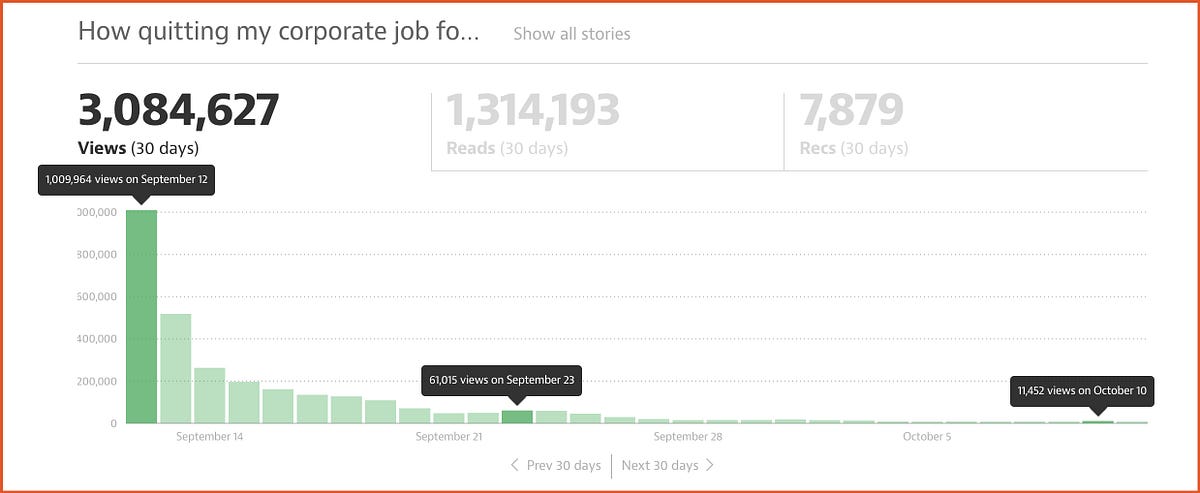
Some weird things have happened since the morning of September 12, 2014, the day 1,009,964 people viewed the story of my Life.
It
was my second article to get big traffic, and since then my life has
become a bit intense at the crossroads of freelancing, startup-ing, and
blogging.
Here is the thing I want to share with everyone in this post:
I
am starting to come up with a set of tactics that have been working
repeatedly for getting huge traffic and visitors, and turning them into
subscribers or followers across all networks.
My
findings come from online marketing, managing social media and growth
for the businesses of friends and clients, and my own work.
But
most of what I’ve learned comes from content marketing and writing,
especially from the 21 ghostwriting pieces I’ve written for clients over
the last few months and from five personal articles on my Medium blog.
Below,
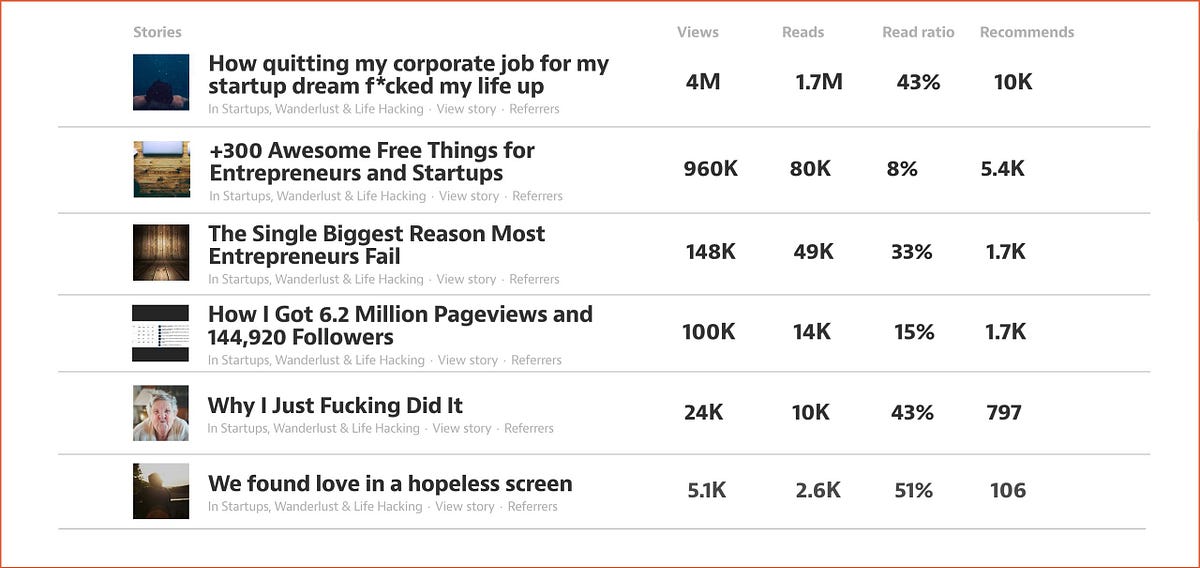
I also shared the latest stats of the Medium pieces and some
translations including the first few weeks performance of the article
you are reading now.
First,
I have to admit that not every article became a hit. Among those 26
essays, only five of them got 6-digit pageviews. Two of them are
reaching 81K and 54K at the time of writing, while the rest currently
average around 8.3K each.
However, the performance is quite pleasing since many of the big blogs I have known average around 1K-10K visitors per article.
I also managed to test a different writing style in a different industry with almost every single article.
This guide is not for you if…
…you
are looking for pro writing tips. I am not a professional writer, nor
can I write a mind-blowing literature piece in English.
This
guide is instead for people like me, who don’t have the best writing
skills or the budget to spend on clicks, but who need to grab the
attention of their audiences through organic storytelling.
This
is for people who believe that from their little desk in their little
rooms from the middle of nowhere, they can generate more traffic and
visitors than those companies with an army of writers.
This
is an article sharing what I’ve learned, and please note, pageviews or
followers count don’t necessarily mean success or good content.
This is to help you get read in an extremely noisy world, and turn those readers into long-term members.
I will structure these tips across four categories:
Part 1 — Before writing:Preparing for the storm & Setting the right engines in place.
Part 2 — Writing:Writing style and essentials of an article that will get huge traffic.
Part 3 — Ready to publish:Things to do when you are ready to hit the publish button.
Part 4 — Post-publishing: How
to get into big media outlets, how to double your blog traffic with
redistribution, and some other channels no one thinks of.
Let’s start with the soft stuff before getting a bit more technical:
→ Part 1 — Preparing for the storm ←
Writing is only part of the story. What you do before publishing an article is as much important as writing. Here is why:
1. The “second chance” effect: Why pageviews mean nothing
People give you a chance by landing on your article among so many other open browser tabs that distract them.
Traffic also disappears very quickly and no one remembers your name the next morning.
By
setting the right engines in place, you get the “second chance” — the
“second touch” point through which you can reconnect with those visitors
and remind them it was you who wrote that article.
Here are some of the key engines:
1.1. To email or not to email
For a long time, I ignored the advice of one of my favorite marketing guys, Noah Kagan, and I decided to place an email subscription form on my website only after more than half of my traffic was gone.
I was too late and was able to collect only 32K email addresses.
After
all those email campaigns, I have to confess that email is now by far
the most effective marketing tool that works for me and for almost every
one of my clients with no exception.
That’s
how I get the first 100 shares. It’s the people I bring in by email who
give me the first boost and put my work in front of many other people,
giving it a chance to spread further.
Set up an email subscription form before it’s too late.
1.2. Other engines for a stronger “second chance”
Finding the right engine depends on your goals.
What do you want your readers to do while they’re reading, or once they finish reading your story?
Follow
you on Instagram? Create an account? Read another post? Watch a video?
Fill out a form? Refer a friend, share, or comment?
If your goal is, let’s say, to get your “second chance” on Twitter, did you put your Twitter handle in the author byline?
Are you an e-commerce fashion brand? Did you place the links at the end of your article to remind your readers, let’s say, about your best-selling product?
Just
like you can turn visitors into subscribers with email, with other
engines you can turn them into social media followers, customers,
watchers, or members.
It’s not that every single article I write is great — it’s because I strengthen my “second chance” engines with every new article, gaining more subscribers, more followers, more clients, etc.
2. Business brand vs. personal brand
This is probably the most important thing to decide before posting content on the web.
If I had the chance to go back, I would definitely go for a business brand and remove my personal brand.
With
a personal brand, every time you need to share or say something, you
start the sentence with “I,” while with a brand you would start with
“We.”
After some time, you start feeling like an arrogant fool. You feel you are too much, or that your voice is too loud.
I
don’t think a personal brand is a bad thing, however. You just have to
make sure it’s right for you. Gary Vaynerchuk writes great stuff about
it, if that helps.
Just be
sure to pick the one that matches your personality and goals before the
storm starts kicking in. Making an ideal combination of the two is also
an option.
3. Tech infrastructure check
Anything can get huge traffic at any random time. More on that in a minute.
But
first: Did you check if your hosting can handle the website traffic if
your post goes viral? Did you test if your email subscription form works
perfectly? Is your blog mobile responsive?
→ Part 2— Let’s write ←
Let’s start typing, now that we are all set with the pre-storm engines in place before a potential storm.
a. Writing style
1. Write as simple as possible, but not simpler.
Every
time I wanted to impress my readers, I tried to write a sophisticated
sentence pretending to be a real writer. However, I ended up
over-complicating things and my editor kept inserting “What do you mean here?” comments.
Obviously no one was getting what I was trying to say, even though my sentences were getting longer and longer.
Here are two tips to keep it as simple as possible:
1.1 No more than 25 words in a sentence
Let the real writers keep blowing our minds. Meanwhile, we’ll try to get our message across as clearly as possible.
25
words is a rough number; it’s a checkpoint I use every time I am stuck
on a sentence. I then just shorten or split the sentence into two
separate ones. The Hemingway app also does a similar job if you need
help.
1.2 No more than three sentences in a paragraph
This
is something I keep doing, but I don’t really recommend it for others
because I don’t think this is a proper way of writing.
With
our attention spans getting shorter every day, your article is
competing for the attention of readers who have 12 other open tabs in
their browser, not to mention never-ending notifications on mobile
phones.
In a
world where people don’t even read my 140-character tweets, I try really
hard not to put more than three sentences in a paragraph and keep
things very to-the-point.
2. Treat your article like a startup
Each
article has a unique audience and each audience has its own problems.
Just like you solve the problems of your users with a startup, I apply
the same logic to my articles.
For
whatever industry or client, I start the article by identifying the
problems of the audience of the story I am writing. This doesn’t mean
you should always share intimate or personal stuff that people can
relate to, though.
Are you
writing about the self-publishing music industry? Before starting, just
ask, what are the problems those musicians face? You can also mix in a
personal tone and write as if your reader is sitting right next to you.
Seriously. Treat your writing like a startup.
3. Perfect trio: Long-form, data-backed, and learnings that do the leg work for readers
For most of my clients, I mix what I have learned from the guys at Buffer and Crew in a trio and this technique became a killer.
Writing long form (1000–1500 words) always pays off. Sharing learnings increases the share rates up to 45 percent, and even further when backed with data or weird science.
P.S. Spot the article below in which I didn’t share any learnings ☺
b. Essentials of a blog post
Everyone has their own style and this is how I structure a blog post in my mind:
1. Perfect combo: Curious headline and eye-catching featured image
Test
it yourself. Try removing the featured image for some time and you will
be impressed by how the analytics will change instantly.
“How” and “Why” in a headline always works, and a “list” title never, ever disappoints (remember, it always depends on other factors, too.). You can also study some interesting headlines on the Medium Top 100 lists by viewing all the last months.
Choosing
a great headline is awesome and choosing a great featured image is
great. But when you bring the ideal two together, it’s just perfect.
2. Introduction
This is, for me, by far the most important section of an article.
You
have a few seconds to convince the reader that you can fulfill the
promise you gave in the headline. It’s in those few seconds that he/she
will decide whether or not to open a new tab.
Pull
her into your story step by step. Change his mind so that he forgets he
had actually landed on an article. Start with a shocking scientific
result, an awkward detail, or a personal story.
Try
starting right in the middle of the story. What time was it? Who were
you with when it happened? Look how Andrew Wilkinson made a great intro
with one of his recent articles:
“That’s stupid — you’re building a lifestyle business,” spat the investor across the table, flashing me a death glare.
I finished reading his article within a few seconds.
3. Body
There are two things I pay extreme attention to in the body:
3.1 Let the reader breathe
Remember, you survived the introduction and pulled the reader into the body.
However, the reader is still in the middle and she is already getting easily tired and is about to open a new tab.
Insert a visual and let the reader breathe.
3.2 Don’t use distracting links
There
is a difference between giving credit to reliable resources and
flooding your article with links just to prove to your reader that you
wrote a high-quality piece.
Always ask, is this resource really relevant? Does your audience really care?
4. End on a high note
You
are playing your final cards. The reader is really tired and has been
going between so many open tabs and mobile notifications.
Ease
up and slow down. Write even simpler sentences. Keep your paragraphs
shorter and your message even more to-the-point when possible.
Recap all your points by showing how you fulfilled the promise, and send her home on a high note.
→ Part 3 — When ready to publish ←
Even when you finish writing your article, the real game is still to begin.
The art of asking people to recommend or share
This
is something I do very often at the end of my articles that not many
people do: I ask the reader to recommend or share the article.
For some of my articles, this simple question has increased the number of shares by up to 32 percent.
People
are not mean — if they don’t share, it doesn’t mean they don’t
appreciate your article. It’s just that some people simply don’t have
the habit of sharing as much as you do. But often if you ask them, they
are kind enough to share your work with their networks.
2. Sending out the newsletter at peak time
The best time to send out an email campaign always depends on your audience, time zones, industry, etc.
Generally,
Sunday 0:00 GMT works for a global audience since people are usually
looking forward to reading new things as the new week kicks in.
However,
I strongly suggest you to split-test the time you send out your
newsletter. Many mail companies like Mailchimp offer growth-hacking
tools to test sending the same email to two different groups of your
subscribers.
For
instance, above is one of the old email campaigns I conducted for a
client. Look at the shocking difference in opening rates, even though
the two groups didn’t have that much of a time difference.
3. Send the first bomb all together
Let’s
say you have figured out the best newsletter timing for your audience
to be Sunday evening at 6:45 p.m. Share the article on your social media
accounts as soon as your email campaign is on its way to people’s
inboxes.
Send the first shot all together consistently across all channels, instead of weakening them by separating into different times.
Always
share the same post on your social media accounts a few other times
over the next few days, covering different time zones.
4. Reproduce the same content on different channels and in different formats
This
is something that generates significant additional traffic. Once you
see that an article is successful, turn it into a new format in a new
channel. Turn your articles into:
Slides and upload them on Slideshare, images on Instagram and Facebook, infographics on Pinterest, or into a video on YouTube.
One of the best reproduction forms is to turn it into a website, a software, or a tool as a side project. Here is something I turned into a website after an article that became one of the most upvoted things on Product Hunt.
→ Part 4— Redistribution ←
The
traffic you see on the Medium screenshots above is only a portion of
the traffic you get. Redistributing on big publishers sometimes can up
to double your traffic.
What
is really interesting is to see how people exaggerate big media outlets
in their minds, seeing them as unreachable, unachievable channels that
only the top guys get into.
The
truth is, editors working for big media outlets are such nice people.
They are not your enemies, and they don’t ignore you on purpose.
They usually have very intense workloads and they need one thing: to bring only the best content to their websites.
Here is how to give them what they need and enjoy huge traffic and exposure.
1. List your targets
Go
on to the “contact” pages of your target publishers or tech blogs, and
get the emails of editors. When there’s no email, search for them on
Twitter. Make your wish list of target editors with all contact details.
2. No traction, no redistribution
Remember:
all they need is traction or proof of a performing article. If you
can’t see the traffic on your Google analytics, there is no way you will
fool the editor into reposting it on their website.
Wait for few days to get some analytics data. Once you see something really great about your article (it doesn’t have to be only traffic, it can also be a great quality content many opinion leaders are referring to) take the screenshot or proof, and then:
3. Send emails or tweet editors with eye-catching headlines
Please don’t email them like:
“Hi, my name is bla,
I am bla bla bla,
I published an article….”
Be to the point and brief. Talk about the results. And talk only if you have results.
Here is a typical email I send and usually receive an answer to:
Title: “My post has 42% share rate, screenshot attached, repost maybe?”
Email: “Hi,
my article is performing really well, pls see analytics data attached. I
want to repost it on your outlet. Please kindly get back if you are
interested. Ali”
4. What? You have 42% shares? Stop doing the tactic above ASAP
If
your article is getting huge traffic or if you are seeing extreme
movements in your analytics data, STOP. You don’t need to do any of the
tactics above because you will be approached by those big media outlets
within a few hours.
Many of them have dedicated employees searching for trending articles on the web for reposting opportunities.
With my viral story, I was approached by four top tech blogs within seven hours of publishing.
5. Beware of Exclusive Agreements
Some media outlets will require you to sign exclusive agreements that prevent you from reposting on other outlets.
It
doesn’t mean exclusive agreements are bad; you just need to understand
which channel has the best audience for that specific article.
I
reposted a viral article on multiple channels such as Business Insider,
Lifehacker, and Tech in Asia. With some other stories, I go exclusively
with The Next Web.
6. Decide when to repost on media outlets
If
your piece is really strong, give it some time to spread on the main
channel you publish on (be it your own blog or on Medium).
Let it wear out at least for a few days; otherwise, big media outlets can easily cannibalize your main channel and split your “one bomb” into pieces.
It all depends, however. For instance, the article below got more traffic on The Next Web than the Medium traffic below.
Some other channels
The right channel
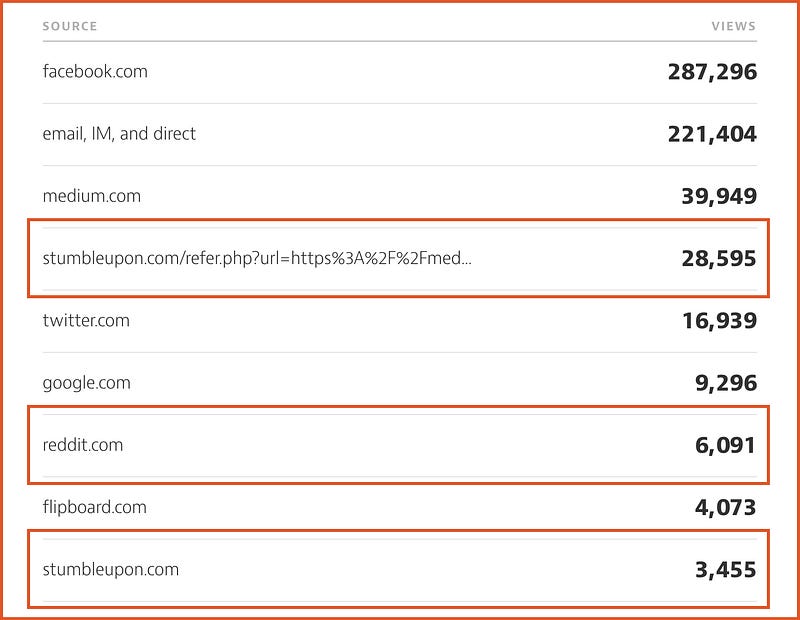
Sometimes it takes time for your content to find the right channel. It took two weeks for this article
to find the right channel: Someone uploaded it on Reddit and
StumbleUpon. Eventually, from these two channels, it started going viral
on Facebook.
One
of Jeff Goins’ articles about traveling started going viral one year
after he published it when a student leader from Singapore shared it on
Facebook with a travel group he led on campus.
There
is no right timing for an article to go viral; however, there is for
sure the right channel. Instead of waiting for others, try looking for
the right channel and submitting your links yourself.
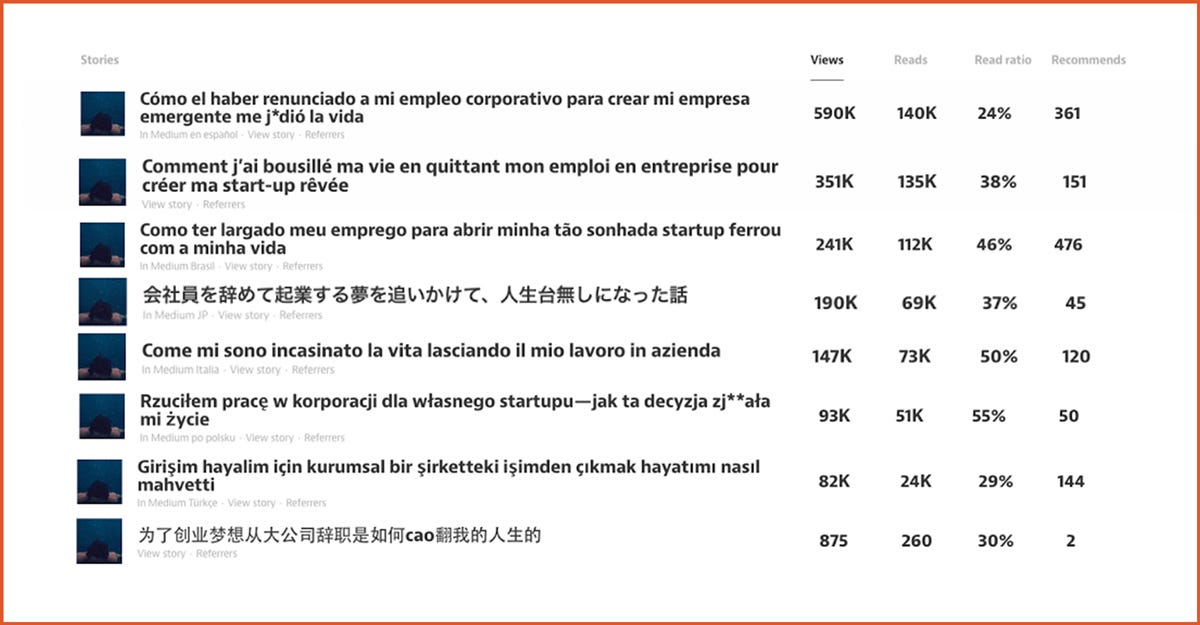
2. Multilingual channel
If
your article has traction and global reach, Medium translates it in
many other languages for you at no cost, and you enjoy the constant
stream of followers and traffic to your links coming from other
countries.
Here are few of those they did for me:
If
you are not writing on Medium, consider testing to hire a freelance
translator once (I suggest Spanish) and ask one of the top tech blogs in
the Spanish community to redistribute it.
3. Fake redistributors
Unfortunately,
many people will repost your article without giving you any credit.
Some people will even go on LinkedIn and repost it as if they were the
author of your articles.
In my case, LinkedIn didn’t even respond to any of my emails where I reported these copyright infringement cases.
If
the number of copy cases is low and manageable, see what you can do
about it. Otherwise, there is no point in freaking out and killing
yourself over it.
→ Final thought ←
I always used to read those people saying “content is king” and I never understood the true meaning of it.
As
a millennial living in an extremely noisy world, I am finding it
increasingly difficult to grab people’s attention and I start feeling
the urgent need to become a better storyteller.
In 2015, I really believe we need to start becoming better storytellers by improving our pitches whenever we talk to people.
We need to become more to-the-point, where our voices are competing with their distracting mobile phones.
Content is truly the king. You can grab the attention of millions of people with a simple story or an article.
Never underestimate yourself or don’t use excuses, like that you don’t have a marketing budget.
From
your little desk in your little room from the middle of nowhere, you
can generate more traffic than companies with an army of writers.
Content is king, and you are the one who rules it.
Thanks for reading! You can get my articles by Email Here